Better in Chorus 2012 - 2019
Social-engaged project, various media
In my early twenties, I spent much of my time in residential care homes across the Tula, Kaluga, and Tver regions. I initially went there in search of historical narratives, hoping to meet people whose lives had intersected with the events I knew only from textbooks. Instead, I encountered something far more meaningful: individual stories, friendships, and shared experiences that resisted the simplifications of official history.
Painting became a way of building relationships. Together with the residents, I made watercolors, collages, and wall paintings, exchanged songs and stories, discussed both classical and contemporary art, and created our own responses to artists such as Ilya Kabakov, Erik Bulatov, and Pavel Pepperstein. We visited museums, organized exhibitions within the care homes, and gradually formed a community of artists, collectors, and viewers. During one summer, I lived in a care home for several weeks, working alongside its residents to transform its interior into a shared exhibition space.
The resulting body of work combines drawings, photographs, videos, and archival materials produced during these encounters. More importantly, it reflects a collaborative process in which artistic practice became inseparable from everyday life. Over time, the distinction between making art and volunteering ceased to matter. What remained was a recognition that the project was never about care as charity, but about mutual attention, creative exchange, and the fundamental desire to be seen not with pity, but with dignity and affection.
Ditties, video, 01:21, 2015
Family Homes (2014 - 2019)
Series of analog photos, variable dimentions.


Holidays (2015)
Mural painting in Tovarkovo nursing home.
During the summer of 2015, Muromtseva spent several weeks living and working in the Tovarkovo residential care home in the Tula region. Together with the residents, she transformed the institution’s main hall by painting decorative “carpets” directly onto its walls. Once a familiar feature of Soviet domestic interiors, these painted textiles evoke a shared visual memory while reimagining the care home as a space of comfort, creativity, and collective authorship.
After completing the murals, residents gathered to take portraits and selfies in front of them, drawing on the long-standing tradition of family and community photography staged against decorative carpets. The project concluded with an exhibition in the care home hall, where the photographs were displayed alongside recordings of songs by Alexander Vertinsky. Combining participatory painting, performance, photography, and installation, the work reflects on domestic memory, shared rituals, and the capacity of collective artistic practice to reshape everyday environments.


Our Answers to Moscow Conceptualism (2015 - 2019)
Paper, watercolor, gouache.
Our Answers originated in a collaboration between Muromtseva and Igor Andrianov, an artist and resident of a care home in the Tula region. After reading a catalogue from Erik Bulatov’s exhibition, Andrianov proposed replacing the artist’s texts with his own reflections on Soviet life and perestroika. The resulting works reinterpreted Bulatov’s paintings through personal memory rather than official history. The series later expanded through collaborations with other care home residents. Subsequent projects responded to exhibitions by Ilya Kabakov and Pavel Pepperstein, following group visits to the State Tretyakov Gallery and the Garage Museum of Contemporary Art. Reworking images and ideas from these artists, participants created collective responses that brought their own memories, experiences, and visions of the future into dialogue with the canon of Russian contemporary art.


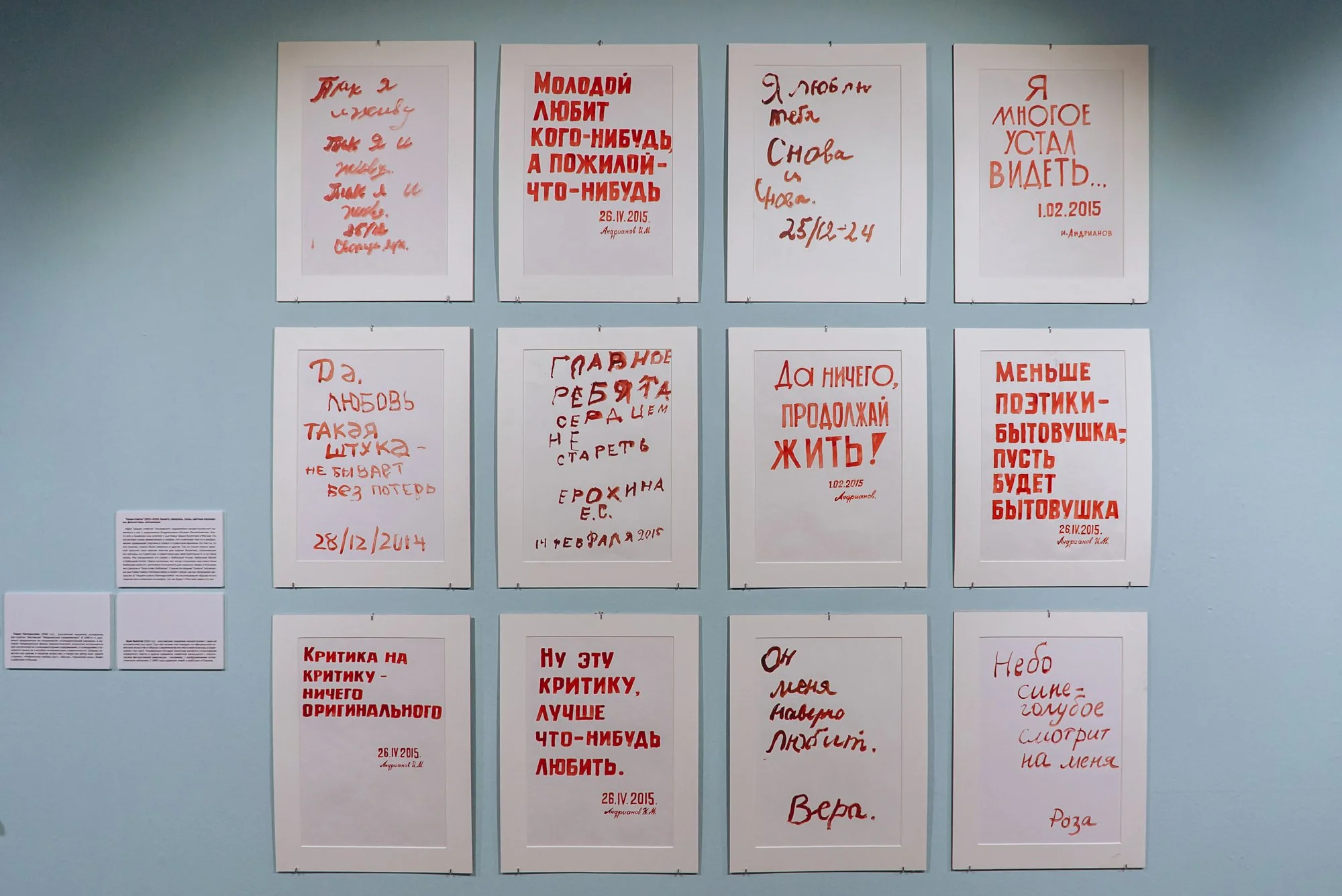
Better in chorus, 2019
Peresvetov pereulok gallery, Moscow, Russia
The exhibition traces Muromtseva’s long-term collaboration with residents of care homes in the Tula region, 193 kilometers south of Moscow. Developed over several years, the project unfolds as a chronicle of shared artistic practice, bringing together murals, collages, photographs, videos, and works on paper produced through dialogue and collective authorship. Among the key works is Holidays (2015), a mural created with care home residents to transform the institution’s austere common hall. Inspired by the decorative wall carpets once found in countless Soviet homes, the painted tapestry evokes a shared visual memory while reclaiming the institutional space as one of comfort and belonging. Also featured is Our Answers to Moscow Conceptualism (2015–2019), a collaborative series responding to the work of Ilya Kabakov, Erik Bulatov, and Pavel Pepperstein. Reinterpreting their imagery and texts through personal memories and lived experience, the participants place their own voices in dialogue with the canon of Russian contemporary art.
Throughout the exhibition, collaboration is understood not as a participatory method but as the foundation of the work itself. Sustained through repeated visits and long-term relationships, Muromtseva’s practice challenges conventional distinctions between artist and participant, foregrounding conversation, mutual learning, and shared authorship as means of rethinking intergenerational relationships and the social role of art.


